
Incoloy 800
Complete analysis of Incoloy 800 alloy (UNS N08800)
I. Implementation standards (by product form)
The technical specifications of Incoloy 800 cover American standards (ASTM/ASME), European standards, and national standards, targeting different product forms:
- Plates/strips: ASTM B409 / ASME SB – 409 (specifies the dimensions, performance, and corrosion resistance requirements for cold – rolled plates and hot – rolled plates);
- Bars/forging billets:
- Bars: ASTM B408 / ASME SB – 408 (hot – rolled/forged bars, including black skin and polished states);
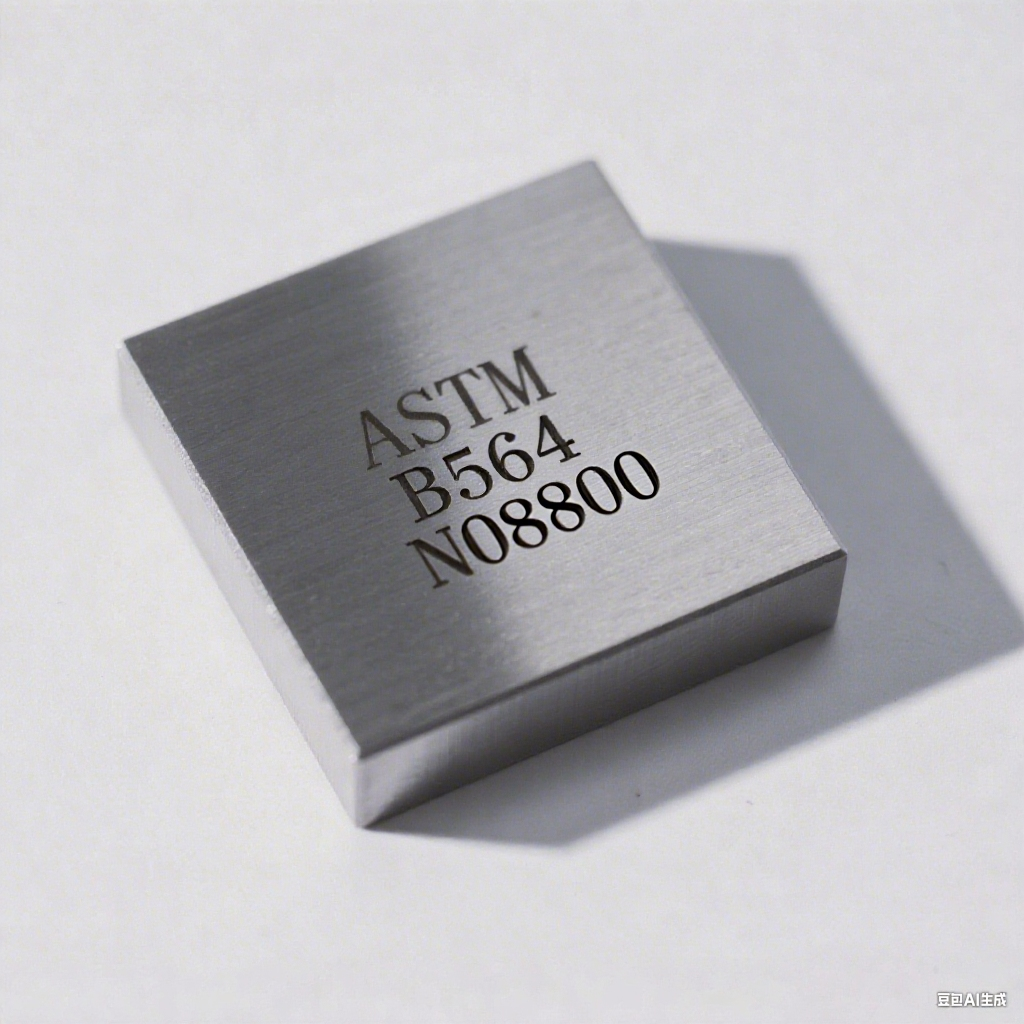
- Forgings: ASTM B564 / ASME SB – 564 (general corrosion – resistant alloy forging standard, with extended coverage);
- Seamless pipes: ASTM B423 / ASME SB – 423 (seamless pipes, focusing on high – temperature corrosion resistance);
- Welded pipes: ASTM B705 / ASME SB – 705 (welded pipes, including submerged arc welding, TIG welding, and other welding processes);
- High – temperature application extension: ASTM A240 (for pressure vessel plates, 800H/800HT are high – temperature optimized types, with strict control of carbon content).
II. Name and Code
- General name: Incoloy 800;
- Authoritative identification:
- American standard: UNS No8800 (core number, internationally used);
- European standard: W.Nr. 1.4876 (Germany), NiCr20Fe32AlTi (component abbreviation, highlighting Ni, Cr, Fe and Al/Ti strengthening);
- National standard:
- GH3080 (Chinese high – temperature alloy grade, focusing on high – temperature strength, corresponding to 800H/800HT);
- NS111 (Chinese corrosion – resistant alloy grade, focusing on corrosion resistance, corresponding to the basic type of 800);
- Other codes: NC15Fe in France, NCF800 in Japan.
III. Chemical composition (mass fraction,%, typical range of ASTM standard)
Incoloy 800 is a nickel – iron – chromium solid solution strengthened alloy, designed through the synergy of Al, Ti for carbon stabilization + Cr for oxidation resistance + Ni for corrosion resistance:
| Element | Content Range | Core Function |
|---|---|---|
| Nickel (Ni) | 30.0 – 35.0 | Stabilizes the austenitic matrix and resists stress corrosion cracking |
| Chromium (Cr) | 19.0 – 23.0 | Resists oxidation (resists oxidizing media, such as high – temperature flue gas) and pitting corrosion |
| Iron (Fe) | Balance (≈39 – 46) | Balances density and cost, and assists in solid solution strengthening |
| Carbon (C) | ≤0.10 | Controls the precipitation of grain boundary carbides (Cr₂₃C₆) and avoids embrittlement |
| Manganese (Mn) | ≤1.5 | Improves hot working fluidity (inhibits hot cracking) |
| Silicon (Si) | ≤1.0 | Optimizes casting structure and inhibits impurity segregation |
| Copper (Cu) | ≤0.75 | Slightly improves corrosion resistance to reducing media (such as dilute sulfuric acid) |
| Aluminum (Al) | 0.15 – 0.60 | Forms Ni₃(Al, Ti) with Ti, stabilizes carbon (inhibits Cr₂₃C₆) |
| Titanium (Ti) | 0.15 – 0.60 | Refines the structure with Al and improves high – temperature stability |
| Sulfur (S) | ≤0.015 | Inhibits hot working cracks (reduces hot brittleness sensitivity) |
IV. Mechanical properties (solid solution treatment state, typical value at room temperature)
After solution treatment (water quenching/air cooling at 900 – 1050°C), Incoloy 800 achieves performance relying on solid solution strengthening + grain boundary stabilization, and can be stably used at -200 – 800°C (800H/800HT optimize long – term high – temperature performance):
| Performance Indicator | Typical Value (Solution State) | Remarks |
|---|---|---|
| Tensile Strength | ≥450 MPa | Can be improved by cold working (e.g., reaches 600 MPa + after cold rolling) |
| Yield Strength (0.2%) | ≥175 MPa | Strength decreases slowly at high temperatures (still ≈200 MPa at 800°C) |
| Elongation (%) | ≥35 | Excellent formability, supporting complex processing such as rolling and welding |
| Hardness (HB) | ≤200 | Soft state, convenient for mechanical processing (cutting/grinding) |
V. Heat Treatment Requirements
- Core Process: Solution Treatmen
- Temperature: 900 – 1050°C (hold for 1 – 2 hours to fully dissolve Al and Ti, and make carbides re – dissolve to obtain a uniform austenite);
- Cooling: Water quenching or rapid air cooling (to prevent the precipitation of Cr₂₃C₆ and Ni₃(Al, Ti) in the 500 – 700°C sensitization zone and avoid intergranular corrosion).
- High – temperature Optimized Types (800H/800HT):
- 800H: Strictly control carbon (0.05 – 0.10%) and grain size, requiring 1050°C solution treatment + 700 – 800°C aging (to precipitate dispersed phases and improve high – temperature creep strength);
- 800HT: Further optimize Al/Ti (0.3 – 0.6%), and have better high – temperature strength after aging (suitable for long – term service at ≥700°C).
VI. Main application fields
Incoloy 800, due to its “oxidation resistance at medium and high temperatures + resistance to multiple corrosions + easy processing”, focuses on complex environments of 500 – 800°C:
- Energy and Metallurgy:
- Heat treatment furnace: Radiation tubes, furnace bottom plates, heating element casings (resistant to 800°C oxidation/carburizing atmosphere, service life over 5 years);
- Nuclear power: Heat transfer tubes of steam generators (resistant to high – temperature water + irradiation corrosion, replacing stainless steel).
- Chemical and Petrochemical:
- Sulfuric acid/phosphoric acid production: Evaporators, heat exchangers (resistant to medium – concentration acid + high – temperature corrosion, such as dilute sulfuric acid at ≤80°C);
- Hydrocarbon processing: Lining of hydrotreating reactors (resistant to H₂S + high – temperature corrosion, anti – hydrogen embrittlement).
- Marine and Environmental Protection:
- Seawater desalination: Reverse osmosis membrane shells, seawater cooling pipelines (resistant to seawater/salt spray corrosion, anti – pitting/crevice corrosion);
- Flue gas desulfurization (FGD): Spray pipes of absorption towers (resistant to high Cl⁻ + SO₄²⁻ mixed corrosion, better than 316L).
- Special Scenarios:
- Food processing (resistant to organic acids, high – temperature sterilization, such as sterilization kettles);
- Aerospace (engine branch pipes, high – temperature fasteners, used after cold – working strengthening).
Supplementary Characteristics
- Corrosion resistance limit: Not resistant to strong oxidizing acids (concentrated nitric acid) and high – concentration chlorides (such as FeCl₃), which need to be avoided;
- Weldability: Compatible with TIG and MIG welding, ERNiCr – 3 welding wire (AWS A5.14) is recommended, and solution treatment is recommended for the welded state (to eliminate sensitization in the heat – affected zone);
- Differences from Incoloy 800H/HT:
- 800H: Carbon 0.05 – 0.10%, focusing on high – temperature creep at 700 – 800°C (such as petrochemical heating furnace tubes);
- 800HT: Al/Ti 0.3 – 0.6%, with better strength above 800°C after aging (such as nuclear industry components).
Incoloy 800 is a “benchmark for medium and high – temperature general – purpose alloys”, and its core competitiveness lies in Ni – Cr – Fe synergy + Al/Ti stabilization. When selecting materials, it is necessary to match the basic type/high – temperature optimized type (800H/HT) based on temperature (≤800°C), medium type (oxidizing/reducing), and service duration.